Skeleton Crew
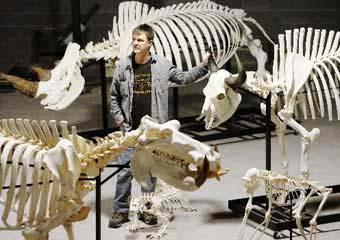
Skull supplier's museum to offer 'educational experience'Remains of rare Javan rhinoceros, manatees, whales are among future displays. Mar 26, 2007 Jeff Raymond, Staff Writer, The Oklahoman Arthur Sterling, president and owner of Bonerelics, stands among some of the full-body animal skeletons that are stored at his company in southeast Oklahoma City. (Photo by Jim Beckel, The Oklahoman) The skeletons of rare animals are so common among collection items for a planned Museum of Osteology, it's easy to forget they're endangered. Or were endangered. The collection includes one of a black rhinoceros, of which only a few thousand are left in the wild, a Hawaiian monk seal and a killer whale. The collection is being held at Bonerelics in southeast Oklahoma City, which is owned by the future museum's founder. An upstairs storage room next to the museum holds everything from a spitting cobra to a black-footed ferret. The museum also has a 130-year-old Javan rhinoceros skull, along with manatees and beaked whales. Altogether, the museum will include more than 1,000 species. The museum sprang from Arthur Sterling's love for animals and their skeletons, and a need to have a place for a growing collection. Although a delay in obtaining permits from the city of Oklahoma City put the museum on hold, Sterling expects to have a "soft opening" late this year. He already has spent about $750,000 on the project. Sterling began harvesting and cleaning skulls two decades ago. He has grown his company into a 15-person supplier to schools, collectors and hunters. Sterling returned in mid-February from an expedition to locate and retrieve a whale carcass from a Massachusetts beach while a crew from the Discovery Channel filmed the operation. The search was in vain. Despite having global positioning system coordinates and digging 7-foot-deep trenches, the expedition team could not find the whale. "Everybody said, 'It's right there,'" Sterling said. No matter - the museum already has more than one whale. A 44-foot-long humpback will hang from the ceiling. Its jaw alone weighs a half-ton. "There's not that many specimens you can name that we don't have in the museum," Sterling said. Museums preferred Zoos typically donate animals that have died, Sterling said, explaining that federal law prohibits them from selling the skeletons. Most zoos prefer to donate an animal to a museum such as his rather than incinerate the remains, he said. "It's a horrible shame to think of a black rhino going in an incinerator," he said of a skeleton he recently acquired from an American zoo he declined to name. When finished, the museum will have glass cases with thousands of skeletons of all sorts of critters, a giraffe that stares at upstairs visitors and a classroom for school group activities. "We want it to be an educational experience, not just a 'wow' experience," said Lucas Sterling, the future museum's director of education. "We're going to try to accommodate all age groups." Bonerelics has appeared on the Discovery Channel's "Dirty Jobs" series and on national and local television. Additionally, Sterling has contracted with a production company to produce a reality show - think "American Chopper" with bones instead of motorcycles. "For the most part, we're the only company in the country that does this to the degree that we do this," he said. Osteological technician Clark Vance would doubtless play a large role in a reality show. The 5½-year employee assembles skeletons once beetles and chemicals have cleaned and bleached them. Griffith enjoys his job and said, surprisingly, the hardest part is not figuring out which bones go where. "Trying to keep everything hidden and neat looking - that's the toughest part," he said of the wires needed to hold together skeletons. Nearby, in a wall container typically used for nuts and bolts, hang extra teeth, a reminder of Griffith's work. Dogs, cats, humans, gorillas and chimpanzees - he can reassemble these with little effort. Two-thousand-pound whales are harder. Bonerelics processes some 25,000 skulls a year. Share: Share on Facebook Share on X Share on LinkedIn Pin on Pinterest Previous article Life as a skull cleaner is a messy job Next article Missing Whale Stumps Museum on Beach Dig