The Bone Collectors
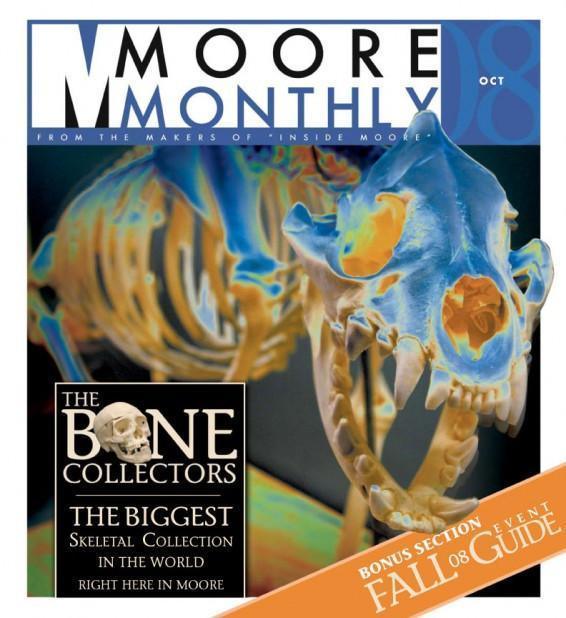
The Biggest Skeletal Collection in the World Right Here in Moore Oklahoma Oct 1, 2008 Brent Wheelbarger, Moore Monthly DOWNLOAD PDF When Arthur Sterling receives a shipment from UPS, it often arrives from a far corner of the world and almost always contains bones. Often those bones are in the form of a dead animal’s carcass, maybe a monkey, an elephant or even a huge whale. Whatever the case, they all contribute to Arthur’s unusual business, Bonerelics. Located on Sunnylane Road, Bonerelics is the world’s largest purveyor of osteological specimens, better known as bones. “I started collecting skulls when I was seven years old,” says Arthur. “I found a dog skull in the woods. My father encouraged me to bring the bones home. Throughout the years, the bones kind of faded away, but the skull had always remained. A few years after that, I found a cat skull on an anthill. From that point, I saw the similarities yet the differences, and it just intrigued me to the point that I had to start the company. ” A Moore High School graduate, Arthur transformed this lifelong interest into a business known across the globe as the place to go when you need a skull. The Biggest Skeletal Collection in the World Right Here In Moore Arthur Sterling, founder of Bonerelics explaining the process of cleaning skulls Beetles, Flensing, Brain Sucker. Today, Arthur’s crew is hauling a massive elephant skull into the shop. “It’s actually a small elephant,” says Arthur. Maybe small by elephant standards, but it still requires several people to carry it. Next to the elephant, there is a box full of carefully wrapped monkey heads in varying degrees of decomposition. Next to that is a leopard skull. Each will be cleaned, assembled and shipped to clients, usually universities or educational institutions. Sometimes a skull is accompanied by an entire body, which is also cleaned and the bones completely reassembled to recreate whatever creature it might be. The entire process is fairly extensive and not for the weak stomached. Once a carcass arrives at Bonerelics, it undergoes what is called flensing. According to Arthur, “Flensing is the removal of the mass tissue. We try to cut as much meat off the bones as we can. It’s a process referred to as flensing opposed to fleshing.” For skulls, there is another item that usually must be removed, the brain. This job is accomplished with the brain sucker, a vacuum-like device that’s inserted into the base of the skull. When it’s turned on, all kinds of pink stuff comes shooting through the clear tube and into a storage tank. Essentially, it just sucks the brain right out. Flesh Eating Beetles and once the major portions of flesh and brain are removed, it’s on to the bug room. “These are carnivorous meat eating beetles,” says Arthur. “They actually remove the tissue from the specimens. The larvae do the majority of the work. The large adult beetles actually do more reproduction than they do consumption. Right now, they’re eating on a black bear skull. And here is the skull of an adult female Komoto Dragon.” The beetles reside within a back room of Bonerelics in very large aquarium-style tanks. Arthur puts the skulls and bones inside the tanks and the beetles have lunch. Over a period of several days, they strip the bones clean of virtually every ounce of flesh. “You do smell that, don’t you?” is a common remark of first time visitors to the flensing and beetle rooms. In fact, the smell is horrendous, creating an immediate gag response upon first entering. There are several workers inside, happily cutting flesh off bones and sucking out brains, completely oblivious to the stench. The beetle room is the worst. It’s kept very humid, and when you enter, the smell kind of sticks to you (for the rest of the day). But it’s all in the name of science and research, and for Arthur and his crew, it doesn’t seem to be a problem. After the flesh eating beetles, the bones and skulls are on to a chemical bath. “Here we have hydrogen peroxide,” says Arthur. “We use that for whitening the bones. It looks like some coyote skulls and a mountain lion skull coming out of peroxide now.” There are Things that Clark Vance, the Master Articulator and his tea have assembled.Giraffes,SeaCreatures,Chimpanzees & even Humans. Clark Vance, Master Articulator a number of other steps that may or may not be used to further clean and sterilize the bones, but eventually, they make it to the articulation room, and Clark Vance, the Master Articulator. This is where the bones get reassembled into their original form. “Figuring out how you’re going to keep it together, especially with large animals, that’s difficult,” says Clark. “Sometimes, it can be very difficult to keep ribs in place because the ribs are so heavy. You get it to a certain spot, but it just wants to come forward or whatever. It’s very challenging.” Clark and his team have assembled everything from giraffes to sea creatures to chimpanzees and even humans. Ligaments must be built, usually involving bolts and special cement-like bonding agents. Sometimes it’s a very big or little task. According to Arthur, “We process skulls as small as a mouse skull and a shrew, which is the smallest in the world, to hump back whale skulls and skeletons. So, we do it all. We have everything you can imagine come through our building. ” Bonerelics processes some of the world’s smallest (ie. shrew) skulls & skeletons From Shrew to Humpback Whale As you can imagine, this isn’t your typical Moore business. In fact, there’s really no other operation quite like it in the world, and the media has taken notice. Through the past several years, Bonerelics has been featured on national television shows like the popular Discovery Channel program, Dirty Jobs. It’s also been featured on MSNBC. And of course, with a subject like this, Ripley’s Believe It or Not has been by for a visit. “Most people don’t expect to find a facility like ours, right here in little Moore,” says Arthur. “They expect something like this to be in California or New York City, but just not in Oklahoma.” And soon, the unique offerings at Bonerelics will expand even further. NATIONAL ATTENTION There’s really no other Operation quite like it in the world. Lucas Sterling, (RIGHT) Bonerelics Director of Education Arthur Sterling, (INSERT) Bonerelics Founder Directly next to Bonerelics is a new building that will take Arthur’s dream to the next level by opening the world of bones tokids and local educators. It will be called The Museum of Osteology, and its development falls on the shoulders of Lucas Sterling, Bonerelics Education Director. “The Museum of Osteology is a culmination of about 13 years of dreaming, planning and scheming by Arthur,” says Lucas. “He started the company Bonerelics 22 years ago and has always wanted an avenue to display the collections that he’s amassed and to give something back to the community. Basically, it’s going to be an nteractive museum that focuses on skeletal structure. We’re going to have 1000 different skeletons exhibited in the museum when it’s all finished. Many thousands of species are going to be represented. A large portion of the museum is going to be devoted to storage of research specimens. Those will be available for researchers, universities, anyone who wants to come around and study the specimens for research purposes.” The museum is about 75% complete and includes two levels of bone displays, many of which are already assembled and on the museum floor. Walking through the main hall, there is what looks like a hippo skeleton, a giraffe and great apes. All told, they currently have about 100 skeletons fully assembled and awaiting placement. When it’s completed, The Museum of Osteology will house a collection like no other. According to Lucas, “The center of the museum will feature a large hall that will have a 42 foot humpback whale suspended. We’ll have an African elephant articulated. Some of the larger specimens include a rhino, hippo and giraffe. Then we’ll have just about every other mammal or bird you can think of in our skeletal collections. Primarily, we’re going to focus on mammals, but we are going to represent the five different classes, which will include birds, reptiles, amphibians the Museum of Osteology Lucas Sterling, anticipating the opening of the Museum of Osteology a larger collection than even the Smithsonian and fish. For mammals, we’ve got gorillas, orangutans, tigers and a whole bunch of stuff that people have never heard of. We’re going to try to represent most of the mammalian orders.” Representing most of the mammalian orders on earth is no small undertaking, kind of a Noah’s Ark of skeletons. It’s been years in the making, and when it finally does open, Lucas expects it to have a larger collection than even the Smithsonian Museum in Washington, DC. “I think it’s really going to add something to local tourist attractions and local museum offerings,” says Lucas. “We’ll compliment other museums such as the Sam Noble museum, which is primarily fossils whereas we’ll be extent species, modern species that exist today. In addition, we’ll compliment the zoo where people can go and see these animals alive. It’s going to be neat. There’s nothing exactly like this in the United States, if not the world.” Early Summer of 2009 Expected opening date of The Museum of Osteology SKULL ARTJoey, an art turned biology major, speaking about his hobby of skull art. it’s a FUSION of two of My Interests After touring the de-fleshing facility,the articulation department and the massive Museum of Osteology, Lucas Sterling still had one more bizarre surprise to share…his hobby of skull art. “The artwork is something that I do personally on the side,” says Lucas. “I’ve been doing it for years. I was an art major before I went into biology. It’s been a fusion of two of my interests. I’ve always used the medium of skulls and bones and natural history items.” Lucas’s artwork is a bit hard to describe. It’s akin to sculpture art, but with skulls, bones, found objects and numerous other items to form eclectic creations he officially terms “wunderkammer,” a collection of curiosities and rarities. “Here in the Midwest, it’s a little offbeat, a little unusual, and I realize that,” says Lucas. “I know that it’s weird to most people, but it’s just what I do. It’s my creative outlet.” And it’s really taken off with certain rock stars, who purchase the creations at a specialty store on Melrose Street in Los Angeles. One fan in particular is Thomas Pendleton, formerly of the hit tattoo themed television show, Inked. Pendleton will soon be launching a new tattoo reality show on A&E, and the folks at Bonerelics will be featured in one of the first episodes. In fact, Pendleton paved the way for Lucas to sell his skull art in L.A. “Skulls kind of seem to come around every once in a while,” says Lucas. “Back in the 60’s, they became a little more popular. Then, you had the southwest crowd. Heavy rock and metal bands throughout the years used them. Now, it seems that every store you go to, you’ll find them.” That being said, don’t expect to find Lucas’s work at Dillard’s anytime soon. But if you’re ever in Los Angeles, The Forgotten Saints shop will be glad to show you the collection. Or, you can always swing by Bonerelics. Unlimited Possibilities Back at the “office,” the crew is working on a big order of cow skeletons for several veterinary schools. The beetles are busy eating off the flesh, the articulator is putting the bones together, and in several weeks, the fullyassembled heifers will be boxed up and shipped out. And the crew can’t seem to get them out fast enough. Business is booming at Bonerelics. Arthur is considering the construction of yet another building on their growing campus to supply the demand. Entrepreneurialism meets natural science meets wild imagination…and amazingly, it’s all right down the street in Moore.Referring to Lucas’s skull art a bit HARD to describe Check out additional photos of the upcoming Museum of Osteology on our website www.mooremonthly.com. You can also see the Inside Moore Television segment about Bonerelics by going to www.cityofmoore.com. Look for the October 2006 episode in the Inside Moore archive section Share: Share on Facebook Share on X Share on LinkedIn Pin on Pinterest Previous article Skull Junkie Finds Solid Future in Skeleton Frontier Next article Uncommon Enterprise